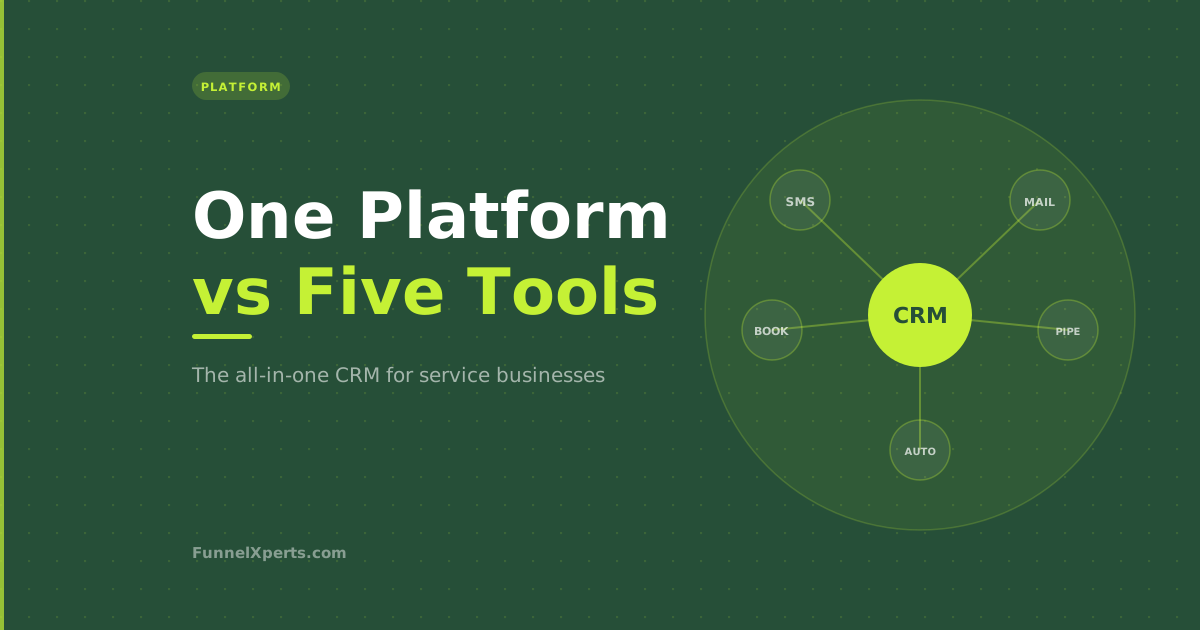
Look at how a typical service business actually runs day to day and you'll usually find the same thing: a CRM or spreadsheet for contacts, a separate app for texting, an email tool for newsletters, a booking link from somewhere else, a review-request tool, and a connector quietly holding it all together with sticky tape.
It works, sort of. Until a customer's details are in one tool but their booking is in another, an integration breaks without anyone noticing, and you're paying five subscriptions for a system that still drops leads.
This post is about the alternative: running the whole thing on one platform. Why service businesses make the switch, what it actually replaces, and where the catch is.
How the Tool Stack Quietly Builds Up
Nobody sets out to run their business on five tools. It happens one sensible decision at a time.
You start with a way to store contacts. Then you realise customers reply to texts far more than emails, so you add an SMS app. You want to send the occasional offer, so you bring in an email tool. Booking by phone is eating your day, so you add a scheduling link. You know reviews matter, so you sign up for something to request them. Each decision is reasonable on its own.
The trouble is that none of these tools were built to work together. They each hold a slice of the customer, and no single one of them holds the whole picture. So you become the integration, copying details between apps, checking multiple inboxes, and remembering which tool does what.
What This Actually Costs You
The fragmented stack costs more than the obvious five subscriptions.
It costs you data. A customer's history is split across tools. Their texts are in one app, their bookings in another, their email history somewhere else. No one can see the full relationship in one place, which means worse service and slower responses.
It costs you reliability. Every connection between two tools is a point of failure. If your review requests depend on your booking app talking to a connector talking to a texting service, that's three things that can break, and when one does, the sequence stops silently. You often don't find out until you notice the reviews dried up weeks ago. We've made this point before in our guide to choosing a CRM for home service businesses: native beats stitched-together, every time.
It costs you automation. The most valuable automations run across the customer journey, a lead comes in, gets an instant response, moves through a pipeline, gets reminded about their appointment, and receives a review request after the job. When each step lives in a different tool, you can't run that journey end to end. You're left automating little fragments and doing the joins by hand.
It costs you money. Five subscriptions, several of them charged per user or per message, usually total more than one flat-rate platform, a point we break down fully in how much a CRM actually costs.
What "All-in-One" Actually Means
An all-in-one platform brings those separate jobs into a single system where they share one customer record and talk to each other natively. In practice, one platform handles:
- The CRM: every contact, with full history in one record
- Two-way SMS: texting from inside the platform, with replies against the contact
- Email marketing: campaigns and triggered sequences from the same place
- Online booking: scheduling links tied to your real availability
- Pipelines: every lead's stage visible at a glance
- Automation: sequences that run across all of the above
- Review requests: triggered automatically after a completed job
The difference isn't that you get more features. It's that they're connected. A lead that comes in by text, books an appointment, and leaves a review never leaves the system, and the automation can follow them the whole way without a single integration in between.
Why This Suits Service Businesses Specifically
This model fits service businesses better than almost any other type of company, for a few reasons.
Your customer journey is genuinely end-to-end: enquiry, quote, booking, job, review, repeat. That journey only automates cleanly when it lives in one place. A platform that handles the lead but hands off the booking to another tool breaks the chain exactly where the money is.
Your team is small and your time is scarce. One login and one place to look is worth real hours every week compared with hopping between apps. And when someone rings, whoever answers can see everything about that customer instantly, instead of checking three tools.
Your follow-up depends on automation that actually fires. Most jobs need several touches to close, Velocify's research points to five to eight, and texts get opened at well over 90% according to Twilio's messaging benchmarks. Those numbers only pay off if the SMS, the pipeline, and the timing all sit in one system that can act on them together. We go deeper on this in lead follow-up automation and GoHighLevel for cleaning businesses.
The Platform We Build On
For most of the service businesses we work with, the all-in-one platform is GoHighLevel. It covers every job on the list above natively, CRM, SMS, email, booking, pipelines, automation, and review requests, on a flat rate that doesn't climb every time you add a team member. It replaces the standalone CRM, the texting app, the email tool, the booking link, and the connector, and it puts the whole customer in one record.
But here's the honest part, and it's the most important thing in this post: the platform is not the hard bit. Signing up for an all-in-one tool and then leaving it half-configured just gives you a more expensive version of the same problem. The value comes entirely from how it's set up, pipelines that match how you actually work, automations that fire at the right moments, and follow-up sequences written for your customers. That's the work, and it's the work most owners underestimate.
That's also where we come in. We don't sell you software and wish you luck, we build the system. We map your customer journey, set up the platform around how your business actually runs, write the automations, and hand you something that's working from day one. The tool is the platform; the result is a system that stops leaking leads.
When a Single Platform Isn't the Answer
To be fair, consolidating onto one platform isn't right for absolutely everyone.
If you're already deeply invested in a piece of specialist software, industry-specific scheduling, dispatch, or field-service software your operation genuinely depends on, ripping it out may cost more than it saves. In those cases the better move is often a CRM that sits alongside it for the sales and marketing side, while the specialist tool keeps running operations. The question to ask is whether your existing tools are load-bearing or just accumulated.
For most owners, though, the stack isn't load-bearing, it's just five subscriptions that grew over time and never got joined up. For them, one platform, set up properly, is simpler, more reliable, and usually cheaper.
What the Switch Actually Looks Like
The fear that stops people consolidating is the migration, the worry that moving everything onto one platform means downtime, lost data, and weeks of chaos. In practice it's far more manageable than the fragmented stack makes it feel, because you're collapsing complexity rather than adding it.
A sensible switch goes in this order. First, get your contacts into one clean list, exported from wherever they live now, de-duplicated, and imported into the new platform. Second, rebuild your customer journey as pipeline stages that match how you actually work: enquiry, quote, booked, job done, review. Third, turn on automations one at a time, starting with the highest-value one, usually instant lead response or quote follow-up, and confirm it works before adding the next. Fourth, point your booking link, your phone number, and your forms at the new system so new leads flow straight in. Only then do you switch off the old tools, one by one, as you confirm nothing depends on them.
Done this way, there's no big-bang cutover and no day where the business goes dark. The old tools keep running until the new system has proven itself, and you retire them on your own schedule.
This is also the part where most owners get stuck, not because it's technically hard, but because building the pipelines and automations properly takes know-how and time they don't have spare. It's the reason we do it for clients rather than handing over a login: the platform is quick to switch on, but the system that actually stops leads leaking is in the setup.
If your business is running on a pile of tools that don't quite talk to each other, book a free systems review. We'll map what you're using now, show you what one platform would replace, and build it around how you actually work, so you get a system, not just a subscription.
Written by Muhammad Naimt Ullah, CRM and automation specialist at FunnelXperts.