You did the hard part. The customer called, you turned up, you worked out the job, and you sent a proper quote. Then... nothing. No yes, no no, just silence. A week later you've half forgotten about it, and the job quietly goes to whoever followed up, or to nobody at all.
This is one of the most expensive leaks in any service business, and it's almost entirely fixable. The customers who go quiet after a quote usually haven't said no. They got busy, the email slipped down their inbox, they're waiting on a partner, or they're comparing you against someone else. A good follow-up doesn't pester them into buying, it simply keeps you in the running until they're ready to decide.
Here's how to make that follow-up happen automatically, every time, without you having to remember a single quote.
Why Quotes Go Quiet (It's Rarely a No)
When a customer doesn't reply to a quote, owners tend to assume the worst: too expensive, not interested, went with someone cheaper. Sometimes that's true. Far more often, the silence means something much more mundane.
They asked three companies and they're waiting to hear back from all of them. They meant to reply and life got in the way. The decision needs a conversation with a spouse or business partner. Your email landed during a hectic week and got buried. None of those is a no, but all of them turn into a no if you don't stay in touch, because the company that does follow up looks more reliable and stays top of mind.
That's the real reason follow-up works. You're not wearing them down. You're being the business that's still there, still helpful, when they finally get round to deciding.
The Cost of "I'll Follow Up When I Get a Chance"
The intention is always there. Every owner means to chase their open quotes. The problem is that follow-up is exactly the kind of task that loses to a busy day on the tools.
Most sales aren't won on the first contact. Velocify's research suggests it takes somewhere between five and eight touches to convert a typical lead, yet most businesses manage one, maybe two, before giving up. Worse, the follow-up that does happen is inconsistent: the quotes you remember get chased, the ones you forget don't, and you've no way of knowing which is which.
That inconsistency is the killer. It's not that follow-up doesn't work, it's that doing it by memory means it only happens for some quotes, some of the time, which is the same as not having a system at all. This is the close cousin of the problem we covered in how contractors lose leads before Monday: the lead was real, the intent was there, and it died in the gap where nobody followed up in time.
What an Automated Estimate Follow-Up Sequence Looks Like
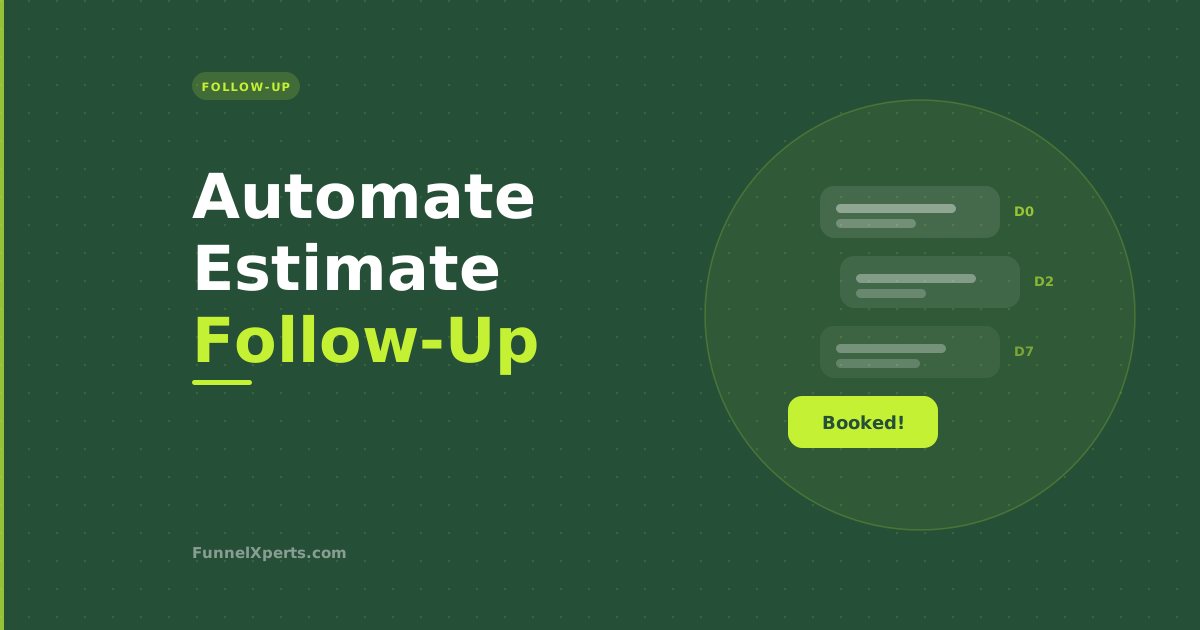
The fix is to build the sequence once and let it run on every quote automatically. The moment you mark an estimate as "sent," a series of pre-written messages goes out over the following days, and the entire sequence stops the instant the customer replies or books.
Here's a sequence that works well for most service businesses:
- Day 0 (right after sending): A short text confirming the quote has landed. "Hi [name], just sent your quote through for [job], give it a look and let me know if anything's unclear. Happy to talk it through." This confirms delivery and opens the door to questions.
- Day 2: A helpful nudge by text. "Hi [name], any questions on the quote for [job]? Always happy to walk through it or tweak anything." You're offering service, not asking for a decision.
- Day 4: A value-focused email. A slightly longer message reminding them what's included, why it's priced the way it is, and what makes you the right choice, reviews, guarantees, availability.
- Day 7: A gentle check-in text. "Hi [name], still keen to help with [job] whenever you're ready. Want me to hold a slot for next week?" Creating a small, friendly reason to act.
- Day 12 to 14: A final "closing the loop" message. "Hi [name], I'll assume the timing isn't right for now, but the quote stands if things change. Just reply and we'll get you booked." This often prompts the reply you've been waiting for, because it signals you're about to stop.
After that, the contact doesn't just vanish, they move into a longer-term nurture, so you can re-approach them weeks later. That's the same principle behind reactivation campaigns: a quiet quote today can still become a job in two months.
The Rules That Keep It From Feeling Pushy
A follow-up sequence only works if it reads like good service rather than nagging. A few principles keep it on the right side of the line:
Lead with help, not pressure. Every message should offer something, to answer questions, to walk through the quote, to hold a slot, rather than simply asking "have you decided yet?". The tone is a helpful tradesperson, not a chasing salesperson.
Stop the moment they respond. This is non-negotiable. The instant a customer replies or books, the automated sequence must stop, and a real person takes over. Nothing feels worse to a customer than getting an automated "have you decided?" the day after they've already said yes. A proper system handles this automatically.
Space it out. Daily messages feel desperate. A touch every two to three days feels attentive. The cadence above gives you six contacts across two weeks without ever feeling relentless.
Mix text and email. Use text for the short, timely nudges, they get opened at over 90%, per Twilio, and email for the longer messages where you make your case in detail. Together they cover both the "quick reply" and the "let me think it over" customer.
Setting It Up So It Actually Runs
Doing this by hand is the very thing that fails, so the point is to automate it. In a CRM with two-way SMS and automation, the build looks like this: you create a pipeline stage called "Quote Sent," you write the message sequence once, and you set it to trigger whenever a quote moves into that stage, and to stop automatically on any reply. From then on, every single quote gets the full follow-up treatment without you doing anything.
This is the kind of journey that only runs cleanly when your texting, pipeline, and automation live in one place rather than across separate tools, which is exactly the case we make in one platform versus five tools. The platform we build this on for most clients is GoHighLevel, because the SMS, pipeline, and automation are all native and the sequence can stop on reply without any manual joining-up.
It's worth being clear about the difference between this and general lead follow-up. Lead follow-up automation is about staying in front of a prospect from the first enquiry. Estimate follow-up is the sharper, higher-value moment right after a quote, these are people who've already had your time and your price, and a small nudge converts a remarkable number of them.
Handling the "It's Too Expensive" Reply
One thing a follow-up sequence does brilliantly is surface the real objection, and for service businesses, the most common one is price. When a customer finally replies with some version of "it's a bit more than we hoped," that's not a failure of the follow-up. It's the follow-up doing its job: turning silence into a conversation you can actually win.
The worst response is to immediately drop your price. That trains customers to push, and it tells them your first quote wasn't honest. The better response is to restate value before anything else: what's included, the quality of the work, the guarantee, the reviews, the fact that you'll actually turn up when you say you will. Often the price was never really the problem, uncertainty was, and reassurance closes the gap.
If price genuinely is the sticking point, offer a change in scope rather than a discount: a phased approach, a slightly different specification, or a payment option. That protects your margin while still giving the customer a way to say yes.
Crucially, none of this should happen on autopilot. The automated sequence gets you the reply; a human takes it from there. That hand-off, automation to open the door, a person to close, is exactly how a good system is meant to work.
The Jobs You're Already Losing
Here's the uncomfortable maths. If you send, say, fifteen quotes a month and a handful of those that currently go quiet would have said yes with a couple of polite nudges, that's several jobs a month walking out of the door, not because you were too expensive, but because nobody followed up.
A sequence you build once recovers those jobs on autopilot, for every quote, forever. It's about the highest-return automation a quoting business can switch on.
If you're sending quotes and losing too many to silence, book a free systems review. We'll set up an automated estimate follow-up sequence built around your jobs and your voice, so you stop losing work you've already done the hard part to win.
Written by Muhammad Naimt Ullah, CRM and automation specialist at FunnelXperts.